
Written by Evy Kariuki
Artistic and media spaces have, for a long time, been overlooked and their significance has been diminished. This has devalued and decentered the art and media space, leading people to forget how essential it is in life, especially for youth who are increasingly making it a lifestyle rather than a hobby.
This shift is evident in the platforms that young people have created for themselves and for future generations. These platforms are not only used for self-expression, but more importantly, to express identity, respond to social issues and build livelihoods.
This growth is happening faster than policy, protection, or regulation can keep up. Examples such as youth-created podcasts, online magazines, photography collectives and youth-led reporting are just some of the many ways young people are reshaping the media and artistic landscape.
Young people have increasingly turned to self-made spaces rather than trying to assimilate into traditional ones they find difficult to fit into. This is largely due to limitations such as a lack of representation in mainstream media, adult-controlled narratives about children and youth and limited access to formal opportunities.
These barriers have strengthened their desire for autonomy and authenticity. As a result, youth have taken control of their own stories, amplifying their voices where they were once spoken for. This highlights how children and young people are reclaiming spaces that affect them and where they believe they should be heard.
These platforms are designed to reflect their own realities, not filtered versions approved by adults. Examples include youth-run media platforms, art used to comment on social issues and young people documenting issues that adults often ignore. This is not rebellion, but rather youth exercising their agency and right to participation.
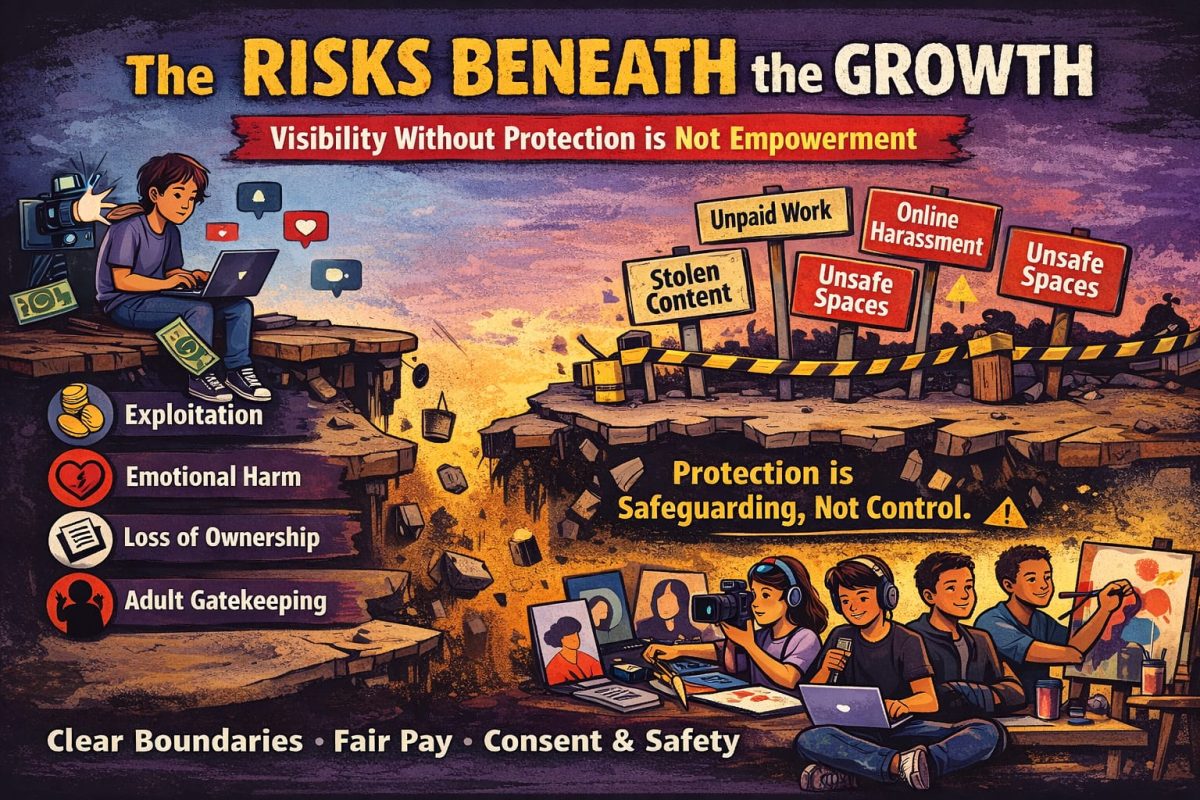
However, this growth also comes with responsibility. The issue is not youth visibility, but visibility without protection. When firm structures are absent, risks increase. These harms are not caused by young people themselves, but occur when adult systems fail to adapt, creating informality that becomes the biggest disadvantage and a gateway to exploitation.
One major risk is unpaid or underpaid labour, often framed as “opportunity” or “exposure.” Expectations for youth to produce content without contracts or compensation reveal power imbalances that are sometimes masked as mentorship. The reality remains clear: learning does not justify uncompensated labour.
There is also the risk of emotional and psychological harm. Early exposure to public scrutiny can negatively affect children and young people who are still forming their identities. This makes them particularly vulnerable to online harassment, criticism and misinterpretation. Many young creators lack the support systems needed to manage backlash or public pressure. This is evident when youth receive significant attention without mental health support, or when children’s stories are debated and criticised by adult audiences without consideration of their well-being.
It is important to clarify that protection does not mean control. Protection is not censorship, restriction, or adult takeover. Rather, it is about enabling creativity to exist without harm. Clear boundaries around who decides what, where responsibility lies and what is appropriate help ensure that youth engagement is ethical and safe.
Respect for agency must remain a central ethical standard across all platforms. Safeguarding measures such as child protection protocols, informed consent and control over images, stories and data are essential. Approaches like child-safe media guidelines, ethical storytelling frameworks and youth-led platforms supported not dominated by adults demonstrate how responsibility can be shared in respectful ways.
Lastly, youth artistic and media engagement is no longer peripheral, it shapes futures. Creative work intersects with education outcomes, employment pathways, mental health and civic participation. Because of this, it cannot exist outside policy, protection frameworks and regulation. When youth creativity influences economies, narratives and social change, it must be recognised and safeguarded within the systems that govern society.