
Written by Chemutai Naomi
When violence forces people to flee their homes, the journey to safety often begins with uncertainty, fear, and the difficult decision to leave behind everything they know. For families living around the Ethiopia–Kenya border near Moyale, crossing into Kenya can mean escaping immediate danger while facing an uncertain future.
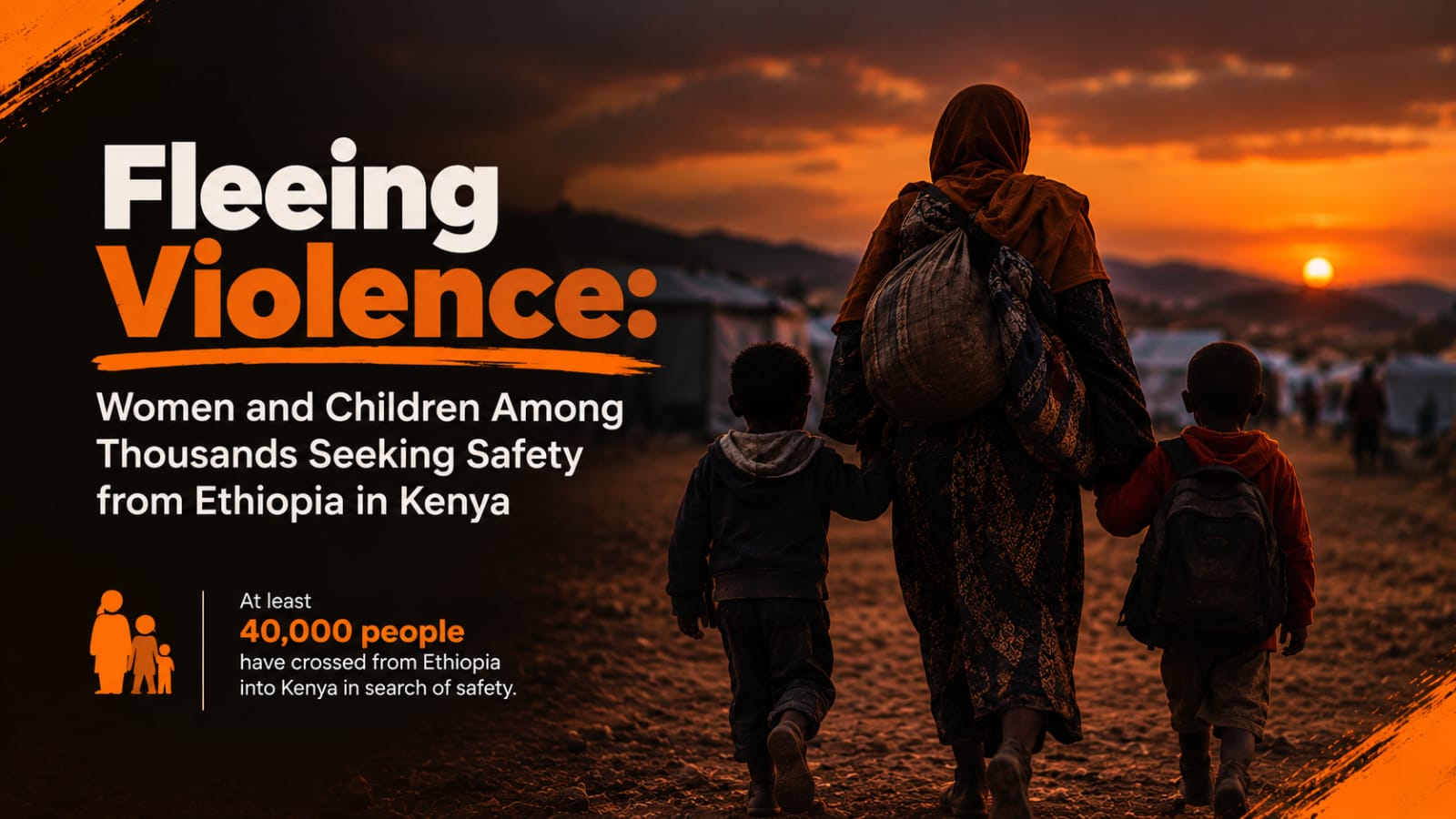
Reports attributed to the Kenya National Commission on Human Rights (KNCHR) indicate that at least 40,000 people have fled violence, crossing from Ethiopia into Kenya in search of safety. Women and children reportedly make up a large proportion of those seeking protection, highlighting the particular risks faced by families caught in conflict and displacement.
Behind this figure are thousands of individual stories: parents trying to protect their children, young people separated from familiar surroundings, and families hoping to find shelter, food, healthcare, and a place where they can live without fear.
The recent displacement has brought renewed attention to the vulnerability of children, mothers, and other civilians affected by violence. According to a statement issued by the Kenya National Commission on Human Rights (KNCHR) on 27 October 2026, approximately 40,000 people have sought refuge in Moyale after fleeing unrest in Ethiopia. The Commission reports that more than 15,000 people are staying in eight temporary shelters, while over 20,000 are living with relatives and friends. Urgent, rights-based humanitarian response to the influx in Moyale
For many displaced families, reaching Kenya is only the first step towards safety. The immediate challenge is finding somewhere to sleep, securing food and clean water, accessing healthcare, and protecting children from further harm.
Women and children are often particularly vulnerable during displacement because their needs can become more difficult to meet when families lose their homes, livelihoods, support networks, and access to essential services.
Children may experience fear, distress, separation from caregivers, interrupted education, and increased exposure to neglect, exploitation, or abuse. Younger children face additional risks when food, clean water, sanitation, and healthcare are scarce. For pregnant women and new mothers, displacement can also interrupt antenatal care, safe delivery, and postnatal support.
The urgency of these needs is reflected in reports from Moyale. KNCHR stated that two women gave birth at Manyatta and two others at Bitiye, highlighting the need for maternal and newborn healthcare, emergency medical services, and postn////atal support.
The Kenya News Agency reported on 25 October 2026 that displaced families urgently needed food, clean water, blankets, tents, mosquito nets, and sanitation facilities. Health officials also raised concerns about overcrowding and inadequate sanitation, while humanitarian teams began providing assistance to affected households. Report on displaced Ethiopians and urgent humanitarian needs
Local residents, relatives, faith-based institutions, government agencies, and humanitarian organizations therefore have an important role to play. Their response can help families meet immediate needs while ensuring that already stretched host communities also receive appropriate support.
The reported displacement of approximately 40,000 people is more than a humanitarian statistic. It represents families whose lives have been disrupted, children whose sense of security has been shaken, and parents who must find ways to protect their loved ones in unfamiliar circumstances.
Every person crossing the border in search of safety deserves humane treatment, access to essential assistance, and protection from further harm. As the situation develops, sustained cooperation and timely humanitarian action will be crucial to ensuring that those fleeing violence can find not only refuge, but also the opportunity to rebuild their lives in safety and dignity.