
Written by Gloria Ngatha
On 6th October 2026 ,Kenya confirmed its first case of Ebola after a Kenyan citizen who had been living in the Democratic Republic of Congo (DRC) tested positive for the virus and later died while receiving treatment at a Nairobi hospital. The Ministry of Health announced the case on Tuesday, 6 October.
The man had lived in the DRC for about seven years and became ill around a month before travelling back to Kenya. He travelled by road from the DRC to Kampala, Uganda, and then boarded a Jambojet flight to Nairobi. He arrived at Jomo Kenyatta International Airport (JKIA) at about 1:10 p.m. on Saturday, 3 October.
After arriving in Nairobi, he was taken to Nairobi Hospital by a relative and a friend. Doctors quickly separated him from other patients after noticing signs that could be linked to a serious viral illness. Tests conducted by Kenya’s National Virology Reference Laboratory and the Kenya Medical Research Institute (KEMRI) confirmed that he had Bundibugyo virus disease, a type of Ebola.
The patient received supportive medical care but sadly died at around 11:30 p.m. on Monday, 5 October. The Ministry of Health said arrangements were being made for a safe and dignified burial according to public-health procedures used for Ebola cases.
Following the death, health officials have started an extensive contact-tracing exercise. So far, 28 people who had contact with the patient, including relatives and healthcare workers, have been identified. Officials are also working to locate 23 passengers and four crew members who travelled on the same flight from Kampala to Nairobi. People considered to have been at risk are being monitored for 21 days.
Kenya says it had already been preparing for Ebola before this case was confirmed. By 6 October, health authorities said they had screened 652,584 travellers, tested 267 samples in five laboratories and trained almost 5,000 health workers on Ebola prevention and management. This patient’s test was the first positive result recorded in Kenya.
The Kenyan case is connected to a much larger Ebola outbreak in the DRC. The outbreak involves the Bundibugyo virus, a rare type of Ebola. According to the World Health Organization (WHO), the outbreak began in the DRC in 2026 and has spread to several areas of the country. By 23 September, the DRC had reported 7,890 confirmed cases and 3,799 deaths.
The outbreak has also affected Uganda, where 20 confirmed cases were reported earlier in the year, as well as France through an infected humanitarian worker who had travelled from the DRC.
Ebola does not spread like a common cold or flu simply because people are near one another. It mainly spreads through direct contact with the blood or other body fluids of a person who is infected, or through objects contaminated with those fluids. People are generally not infectious before they develop symptoms.
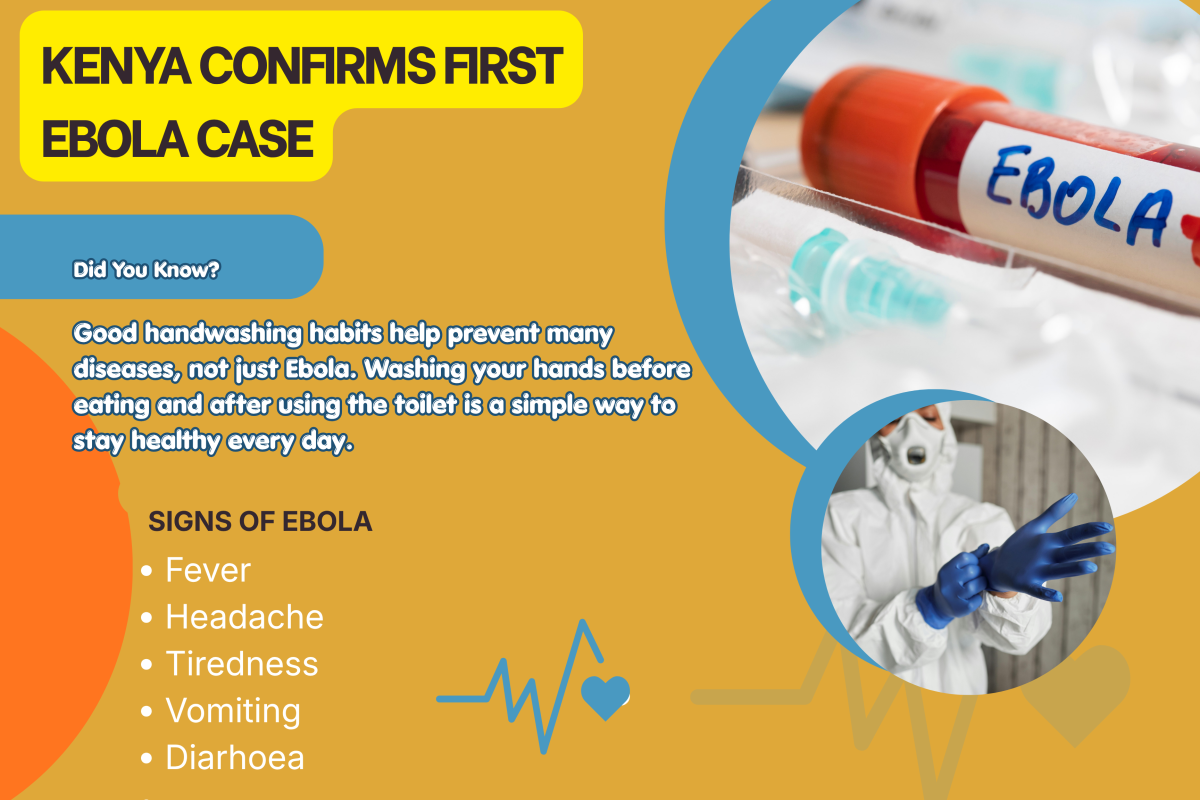
Early symptoms can include fever, tiredness, muscle pain, headache and a sore throat. Because these symptoms can look like other illnesses, health workers need testing to confirm whether someone has Ebola.
For children and families, health officials are urging people not to panic or spread rumours. Good hand hygiene remains important, and anyone who becomes unwell should tell a parent, guardian, teacher or another trusted adult and seek help from a recognised health facility. People should also avoid close contact with anyone who is seriously ill until health professionals provide advice.
The WHO says the Bundibugyo virus currently has no approved vaccine or specific treatment, although research and trials are underway. Supportive medical care is an important part of treating people who become sick.
Kenya’s Health Cabinet Secretary Aden Duale has reassured the public that the government has response systems in place and has urged Kenyans to stay calm, follow health advice and rely on information from official health authorities.