
Written by Gloria Ngatha
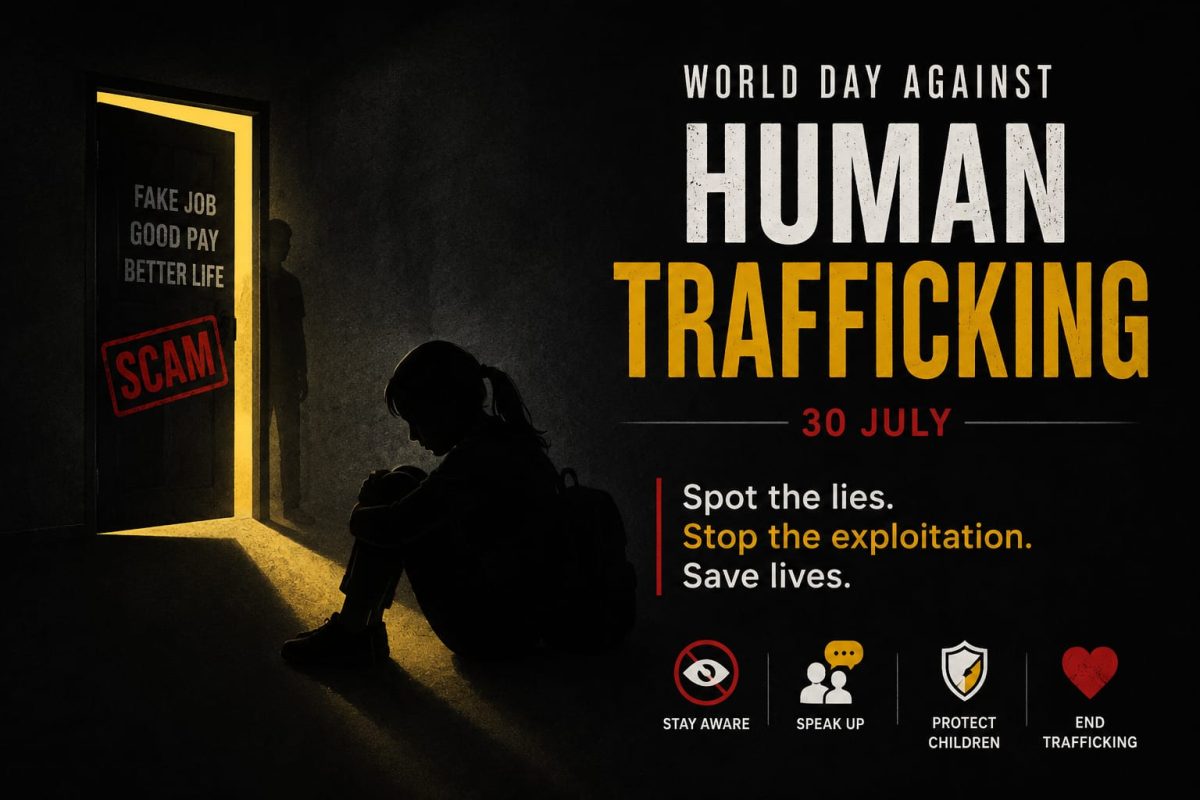
Every year on 30 July, the world comes together to mark the World Day Against Trafficking in Persons to raise awareness about human trafficking and encourage governments,organisations,and communities to protect victims and prevent this crimes from continuing .The day was established by the United Nations General Assembly in 2013 through Resolution A/RES/68/192 ,following the adoption of the United Nations Global Plan of Action to Combat Trafficking in Persons in 2010 ,it was created to promote and protect the rights of trafficking victims while strengthening global efforts to prevent trafficking ,prosecute offenders,and support survivors.
The year’s 2026 theme is “Trapped Behind the Scam.” which focuses on a growing problem where criminals use fake job offers and online advertisement to trick people .Many victims believe they are travelling for a good job or a better future ,but instead they are forced to work in scam centres where they are made to trick people through online fraud .The campaign reminds everyone to think carefully before trusting opportunities found online, especially young adults and vulnerable children who are tricked by fake job offers and forced to take part in online scams.
Human trafficking happens when someone is tricked ,forced or threatened into doing work or activities against their will ,Traffickers may promise jobs ,education ,money or a better life,but instead take away that person freedom and exploit them
Many people think trafficking only happens when someone is taken to another country. However, this is not true. It can happen within the same town, county or country. Trafficking often begins with lies, fake promises or someone pretending to be trustworthy.
Today, traffickers are using the internet more than ever before. According to the United Nations Office on Drugs and Crime (UNODC)Global Report on Trafficking in Persons, many victims are recruited through fake job advertisements shared on social media, messaging apps and fake recruitment websites. Some victims have their passports taken away and are forced to work in places known as scam compounds, where they are made to carry out online scams such as fake investments, romance scams and cryptocurrency fraud.
Children are among those most affected by human trafficking. The latest UNODC Global Report on Trafficking in Persons shows that children make up about 38 per cent of detected trafficking victims around the world. Girls are more likely to be trafficked for sexual exploitation, while boys are often forced into labour, begging or criminal activities.
Children who live in poverty, are separated from their families, are out of school or have been affected by conflict or disasters are at greater risk because traffickers often take advantage of their difficult situations.
Human trafficking remains one of the world’s biggest human rights challenges. According to the International Labour Organization (ILO), the International Organization for Migration (IOM) and Walk Free, around 50 million people were living in modern slavery in 2021. About 28 million were trapped in forced labour, while another 22 million were living in forced marriages. UNODC also reports that the number of detected trafficking victims increased by 25 per cent between 2019 and 2022, while cases of forced labour rose by 47 per cent.
Experts say traffickers often target people who are looking for work or trying to help their families. Poverty, unemployment, conflict and climate disasters can make people more likely to believe fake promises. Many of these fake opportunities are shared through social media, messaging apps and fake recruitment websites.
Children and young people can stay safe online by following a few simple tips:
- Never trust job offers or scholarships that sound too good to be true.
- Talk to a trusted adult before accepting any online opportunity.
- Never share personal information with strangers online.
- Be careful when chatting with people you do not know.
- Report suspicious messages, fake job adverts, or requests for money to a trusted adult, teacher, or the police.
Parents and teachers also play an important role by talking openly with children about online safety and helping them recognise warning signs.
Governments, police, and international organisations are working together to stop trafficking.
UNODC is helping countries improve investigations, rescue victims, and prosecute traffickers. INTERPOL has also warned that scam centres have spread beyond Southeast Asia to other regions, making international cooperation more important than ever.
Technology companies are also being encouraged to remove fake job advertisements, detect online scams, and make digital platforms safer for users.
As we mark the World Day Against Trafficking in Persons, it reminds us that trafficking is changing with technology. Criminals are using social media, messaging apps, and fake websites to target people in new ways.
Children have the right to grow up in safe families, attend school, and dream about their future without fear of exploitation. By learning the warning signs, speaking up, and supporting survivors, communities can help stop traffickers and protect children everywhere.