
Written by Alice Njoki
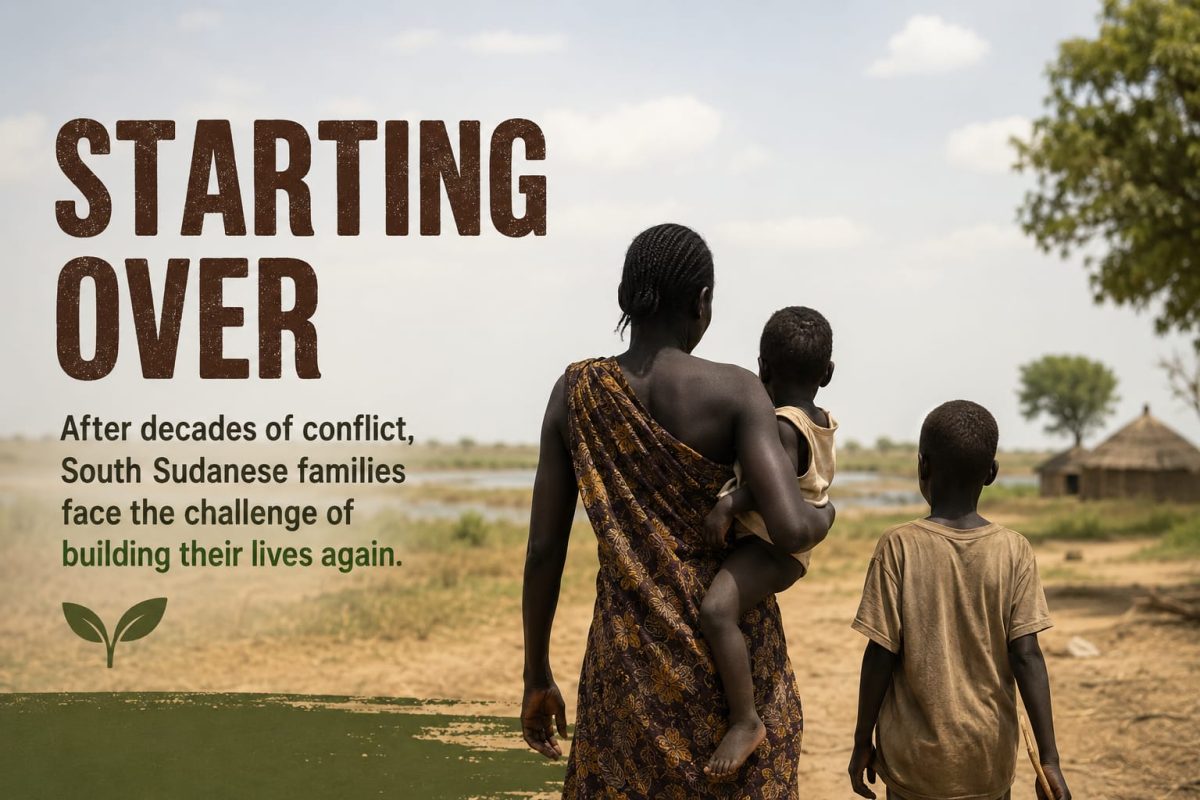
South Sudan has been independent for 15 years, but many families are still living with the effects of decades of war. Millions of South Sudanese have been forced from their homes by conflict, and many who return face another challenge ,rebuilding their homes, livelihoods and communities in a country still dealing with violence, food insecurity and displacement.
Before becoming an independent country, the area that is now South Sudan was part of Sudan. Tensions between the northern and southern regions had existed for years, including disputes over political power, economic inequality, resources and regional autonomy.
Sudan’s first civil war began on August 18 in 1955, just before the country gained independence from Britain. The conflict ended in 1972 with the Addis Ababa Agreement, which gave the southern region a degree of autonomy. But the peace did not last. In 1983, another civil war began after the Sudanese government abolished southern autonomy and introduced policies that deepened existing tensions.
The Second Sudanese Civil War lasted more than two decades and became one of Africa’s longest conflicts. More than two million people died and around four million were displaced during the war. Many people fled across borders into neighbouring countries, while others were displaced within Sudan.
A major turning point came in 2005 when the Sudanese government and the Sudan People’s Liberation Movement signed the Comprehensive Peace Agreement. The agreement ended the Second Sudanese Civil War and provided for a referendum in which people in southern Sudan could decide whether to remain part of Sudan or become independent.
In January 2011, almost 99 percent of voters chose independence. On 9 July that year, South Sudan became an independent country.
For a population that had experienced generations of conflict, independence was a moment of hope. But the new country soon faced its own political crisis.
In December 2013, political tensions between President Salva Kiir and his former vice-president Riek Machar escalated into fighting in Juba and quickly spread to other parts of the country. The conflict developed along political, military and ethnic lines and resulted in widespread violence and displacement.
Hundreds of thousands of people were forced from their homes in the early stages of the conflict, and millions were displaced over the following years. A peace agreement signed in 2018 created a path towards ending the conflict, but it did not bring an end to all violence. Political tensions, localised fighting and intercommunal violence have continued in parts of the country.
The effects of this history can still be seen in the lives of families today. People who fled may have spent years living in refugee settlements or other parts of the country. Some lost their homes, farmland, livestock or businesses. Children may have grown up away from their original communities, had their education interrupted or moved several times as their families searched for safety.
The scale of displacement remains enormous. As of June 2026, UNHCR recorded 2,459,818 South Sudanese refugees and asylum-seekers living in neighbouring countries. Uganda hosted the largest number, followed by Sudan, Ethiopia and Kenya. Nearly two million people were also internally displaced within South Sudan.
At the same time, South Sudan is receiving people fleeing another conflict across its border. Sudan and South Sudan are separate countries, but they share a long history and a border. Since war broke out in Sudan in April 2023 between the Sudanese Armed Forces and the Rapid Support Forces, hundreds of thousands of people have crossed into South Sudan seeking safety.
This means that when we hear about refugees and displacement in South Sudan, there are different stories behind the numbers. Some are South Sudanese who fled conflicts in their own country and remain in neighbouring states. Others are displaced within South Sudan. At the same time, Sudanese refugees and people returning to South Sudan have been arriving because of the war in Sudan.
For South Sudanese families returning home, crossing the border is therefore not necessarily the end of their struggle. Returning does not always mean returning to the same home, community or livelihood they left behind.
A family that once depended on farming may return without livestock, seeds or tools. Homes may have been damaged or abandoned for years. Markets and services may be limited, while flooding can destroy crops and make farming even more difficult. For children, returning can also mean adjusting to a new school, catching up after interrupted education or rebuilding relationships in communities they may barely remember.
In Malakal, UNHCR has highlighted a farming cooperative bringing together returnees, refugees and members of the host community. Members have received agricultural training, seeds and solar-powered water pumps to support vegetable farming. The aim is to help people produce food, earn income and become more self-reliant.
For a family trying to start again, having the means to grow food or earn an income can make a significant difference. It can help reduce dependence on emergency assistance and give parents and caregivers greater ability to meet the needs of their households.
Children are often affected by circumstances they have no control over. They do not decide when a family has to flee, where they will live or whether they can continue going to school. But when conflict forces a family from home or takes away its source of income, children can experience the consequences through hunger, disrupted education and difficulty accessing healthcare and other essential services.
South Sudan continues to face a serious food crisis. In April 2026, UNICEF, the Food and Agriculture Organization and the World Food Programme reported that 7.8 million people were facing high levels of acute food insecurity between April and July 2026. The assessment also found that 2.2 million children aged six months to five years were experiencing acute malnutrition, while about 700,000 children were projected to face severe acute malnutrition during the same period.
Renewed violence has made the situation even more difficult in some areas. In February 2026, UNICEF reported that violence in Jonglei State had displaced around 250,000 people and placed more than 450,000 children at risk of acute malnutrition. When families are forced to move again, the cycle becomes harder to break ,homes are left behind, livelihoods are interrupted and children can lose access to essential services.
This is why recovery cannot simply mean helping people return to a particular location. Families also need opportunities to support themselves once they arrive. They need access to land and livelihoods, food, healthcare, education, clean water and protection. Children need safe and stable environments where they can learn and grow without their lives repeatedly being disrupted by conflict.
South Sudan’s history is long and complicated, and there is no single reason why displacement continues. Decades of civil war, the conflict that followed independence, localised violence, political tensions, flooding and food insecurity have all contributed to the challenges communities face today.
Yet alongside the crisis, people are still rebuilding.