
written by Alice Njoki
“Free Education In Kenya” Millions Allocated But Many Children Still Struggle in Poor Classrooms and Unequal Schools.
President William Ruto recently said that the government cannot fund schools to be entirely free. He explained that even though education takes a huge part of the national budget, it is still not enough to cover everything from teacher salaries to classrooms, books, and learning materials.
But while parents are still paying for uniforms, lunch, transport, and other school costs, some politicians and community projects are trying different approaches. This has sparked debate about fairness, regional inequalities, and how public money is actually used.
Education Gets the Most, But Are Children Benefiting?
Kenya’s 2025/26 budget heavily prioritizes education, allocating around KSh 702.7 billion, almost 28% of the total budget for schools:
- Teachers Service Commission (TSC): KSh 387.2B (including KSh 7.2B for intern teachers and CBC training)
- Free Day Secondary Education (FDSE): KSh 51.9B
- Junior Secondary Capitation (JSS): KSh 28.9B
- Free Primary Education (FPE): KSh 7B
- National Examinations: KSh 5.9B
- School Feeding Programme: KSh 3B
- Infrastructure Development (Primary & Secondary): KSh 1.7B
- Higher Education Loans Board (HELB): KSh 42.5B
- University Student Scholarships: KSh 16.9B
- TVET Capitation & Scholarships: KSh 7.7B
- TVET & Entrepreneurship Project: KSh 4B
These funds are meant to support teachers, pay for school basics, improve infrastructure, fund exams, provide feeding programs, and offer higher education support. On paper, it seems enough ,but in classrooms across the country, children still face challenges. Not every child experiences the benefits of this budget equally.
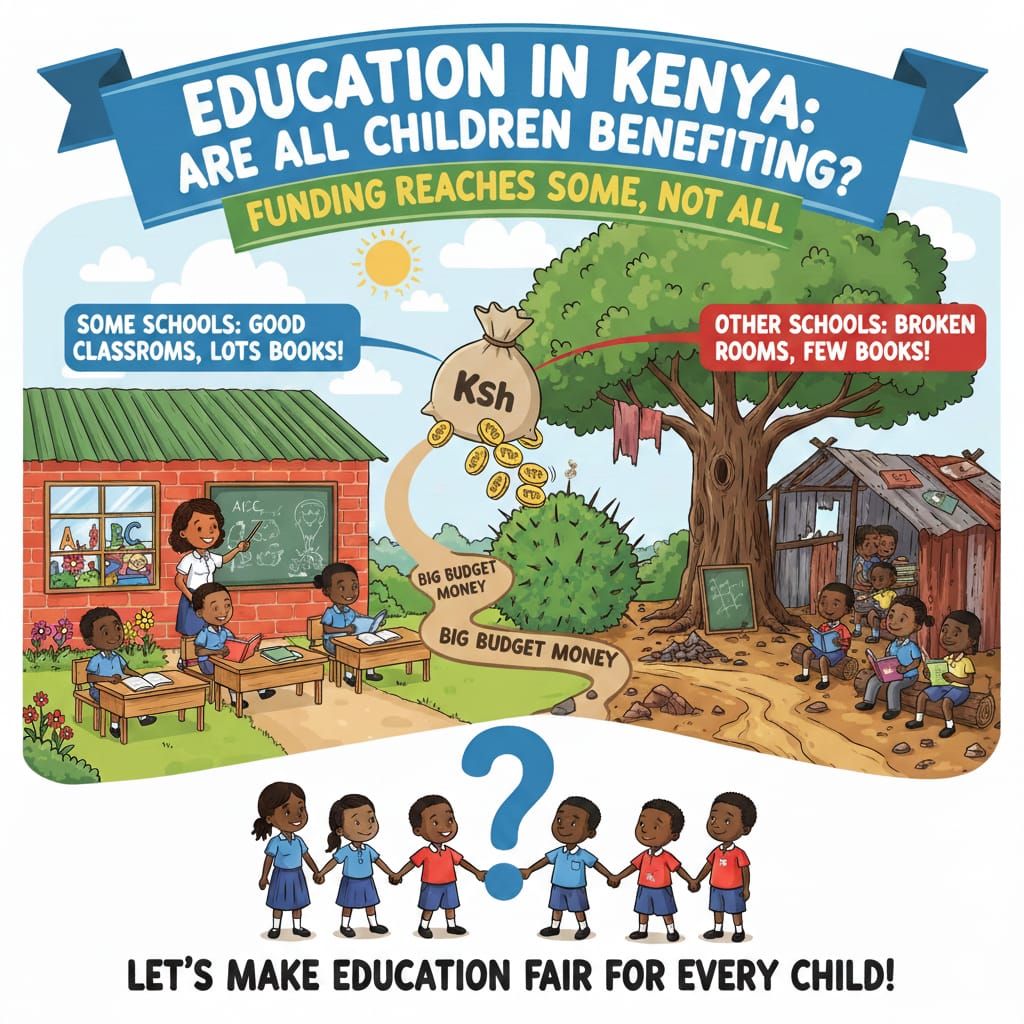
While many schools in central Kenya have relatively good classrooms and adequate learning materials, some schools in the region still face challenges. Similarly, in other areas such as West Pokot and remote parts of Eastern and Coastal Kenya there are schools that struggle with dilapidated classrooms, overcrowded classes, and limited access to books and resources, though a few schools in these regions are better equipped. These differences show that there is uneven distribution of educational resources across the country.
These differences have raised questions about accountability. Even though funding is available, it does not always reach the classrooms where children learn. This is why some parents feel that “free education” is only on paper.
Previously in Kiharu Constituency, MP Ndindi Nyoro launched the Masomo Bora programme, where parents pay only KSh 500 per term for day secondary schools. While this doesn’t make education fully free, it has helped reduce costs for families and ensure schools can run smoothly.
If local initiatives can work like this, other parents wonder, why are other regions still struggling despite receiving large allocations?
Adding to the discussion, former Deputy President Rigathi Gachagua recently sparked debate by suggesting that qualified students from the Mt Kenya region should have priority in regional national schools like Alliance and Mang’u. He argued that this is fair because communities invested heavily in these schools, while other regions failed to build enough local institutions.
This debate highlights a bigger challenge across the country ,not all regions have the same opportunities for learning ,while some areas benefit from well-established schools and strong community support, other regions particularly in the marginalized areas face overcrowded classrooms ,limited facilities and even disruption from insecurities like in some places in the west pokot region, children are sometimes forced to abandon their classrooms and study under trees as teachers and community try to utilize the little infrastructure that they are left with. These gaps shows how unequal education is shaped by a combination of insecurities, underinvestment ,weak systems ,and local challenges that directly affects children daily learning experiences .
Critics say his remarks risk tribal undertones, but the bigger issue is that some regions have well-funded schools with strong infrastructure, while others are underdeveloped. This imbalance forces children from less-developed areas to travel far or learn in poor conditions, even though the national budget is supposed to support them.
For Kenyan children, these debates affect whether a classroom has a roof or enough desks ,whether students can afford uniforms, books, or meals or how much support children get to actually learn. Even with billions allocated to education, many children are still paying the price for delays, mismanagement, and inequality
Part of the challenge is not just how much money is allocated, but how it is used. Even when schools receive large budgets, delays in sending the funds, weak monitoring, and differences in how different counties manage programs mean that resources often do not reach the schools that need them most. As a result, some schools have enough classrooms, desks, and learning materials, while others continue to struggle.Reports on Kenya’s education system show that gaps in classrooms, learning materials, and facilities continue to affect children’s ability to learn, even when funding is provided
The national conversation continues, if the money exists, why are classrooms still in poor condition? And why do some regions get better schools while others lag behind?