
Written by Jermaine Magethe
We wouldn’t dream of letting a seven-year-old wander through a crowded, midnight city alone. We understand the physical world has boundaries, shadows, and risks that a child is not yet equipped to navigate. Yet, every day across Africa, we hand our children smartphones equipped with standard “adult” SIM cards. In doing so, we hand them a passport to a digital wilderness; a world where the exit signs are hidden, the “policing” is handled by distant algorithms, and the content was never designed with their developing minds in mind.
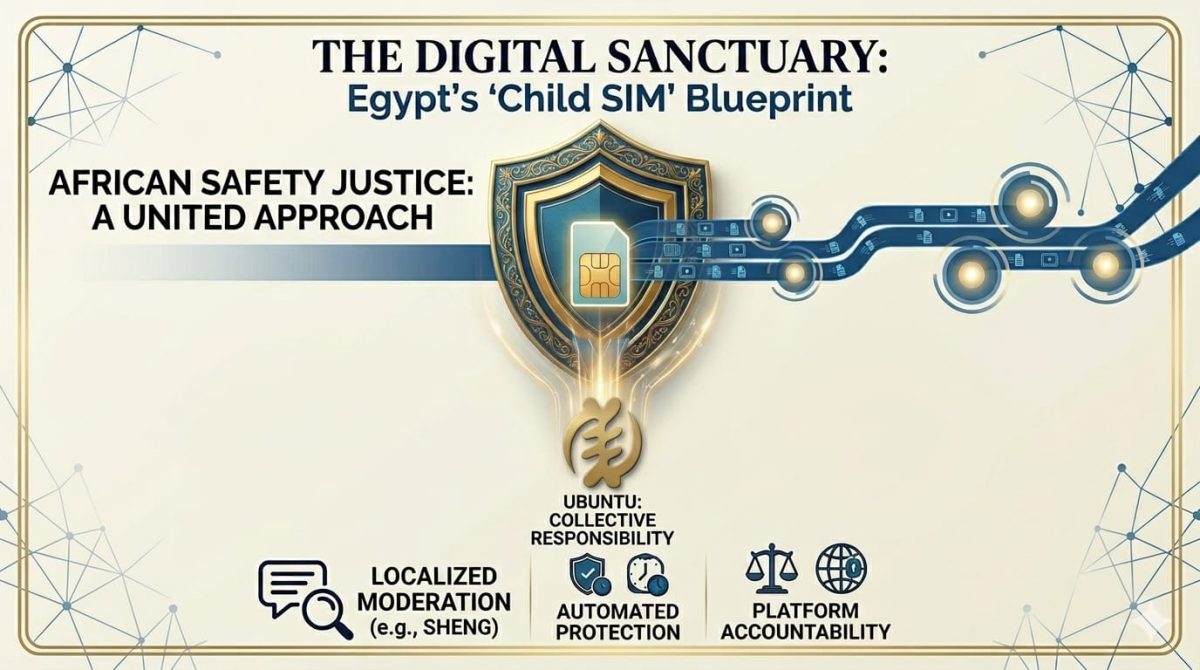
For too long, we have treated digital safety as a series of “parental tips” or optional app settings. Egypt’s recent announcement has signaled that the time for “tips” is over. The era of infrastructure has begun. By mid-2026, Egypt will launch a first-of-its-kind “child SIM card,” announced by Cabinet Spokesman Mohamed El-Homosany and backed by President Abdel Fattah El-Sisi. This initiative is not just a new product; it is a systemic intervention.
The framework moves protection from the surface of the screen down into the hardware. It features; secure internet packages, age-based social media restrictions, and a “fixed internet control” mechanism. By coordinating directly with telecommunications operators, the Egyptian government is ensuring that content classification and parental controls are baked into the terminal devices themselves. This is a move toward “Safety by Design”, where the burden of protection shifts from the overstretched parent to the network provider.
The initiative is grounded in comprehensive legislation. Prime Minister Mostafa Madbouly directed the swift completion of a draft law on internet child protection to address a range of digital threats, including online betting, counterfeit currency distributed through video games, and digital addiction. This legislative backbone distinguishes Egypt’s approach from mere corporate voluntary compliance but embeds child safety into the regulatory framework itself.
The scope of the governance framework is ambitious.It mandates the activation of protection tools on digital platforms, including age verification, parental controls, and content classification. It also requires enhanced transparency through periodic reports, user complaint mechanisms to monitor compliance, and the launch of awareness campaigns promoting safe and responsible internet usage. For the first time, digital platforms will face accountability on a national scale.
This development is a significant moment for “Safety Justice” in the Global South. For years, African nations have been victims of a form of algorithmic colonialism. We have relied on moderation tools designed in Silicon Valley tools that often fail to understand our local nuances, our cultural values, or the “algospeak” and coded slang (like Sheng in Kenya) used to bypass safety filters.
When safety is an afterthought, African children fall into the “invisible safety gap.” Egypt’s move is a declaration of digital sovereignty. It suggests that a child’s right to a safe online experience is not a luxury provided by a foreign tech giant, but a non-negotiable obligation of the state and the telecom industry. The government has positioned protecting youth from digital risks as a matter directly tied to national security, signaling that this is not a peripheral policy concern but a central pillar of state responsibility.
This framing aligns with the African Union’s Child Online Safety and Empowerment Policy (2024), which calls for a “whole-of-society” approach to digital protection. Egypt is among the first AU member states to translate that abstract policy into tangible, hardware-based infrastructure. The shift from “Safety by Advice” to “Safety by Design” is not merely technical but philosophical. It recognizes that dignity and protection are structural, not aspirational.
The Egyptian model offers a radical solution that countries like Kenya and other African nations should closely observe. While we have made strides through digital literacy programs and classification frameworks like the Kenya Film Classification Board , we still largely operate on a “reactive” model by responding to harms after they occur.
A “Child SIM” infrastructure offers a proactive alternative. For Kenya, integrating such a hardware-based shield with our existing cybersecurity frameworks could achieve three critical goals:
- Automate Protection: Provide a baseline of safety that doesn’t require parents to be tech experts. In a context where digital literacy disparities remain significant across rural and urban communitiesgg network-level protections serve as a democratizing force. A parent in a small town in Kisumu has the same defense infrastructure as a parent in Nairobi’s tech hubs.
- Localize Moderation: Allow for filters that understand local context and “coded harms” that global algorithms miss. Sheng, TikTok slang, and the weaponization of emoji combinations are not on Silicon Valley’s radar. A Kenyan-designed, Kenyan-controlled SIM framework could embed this local intelligence directly into the network.
- Enforce Accountability: Force digital platforms to align with local safety laws if they wish to be accessible on these secure networks. Currently, global platforms dictate the terms of what is “acceptable.” A child SIM infrastructure flips that power dynamic, making platforms answerable to African regulators, not the reverse.
Kenya is not starting from zero. The National KE-CIRT/CC (Cybersecurity Incident Response Team) and initiatives like the Parents and Digital Literacy Programme (PADIL) have laid groundwork for systemic thinking about digital safety. The next step is to integrate these efforts into a hardware-level intervention. Telecommunications operators like Safaricom and Airtel Kenya have the infrastructure and reach to pilot such a model across the East African Community (EAC).
As we look toward the future of the African digital landscape, we must ask ourselves a hard question: Is it enough to tell parents to “watch what their kids do,” or is it time we built a digital environment that actually watches out for our kids?
The Egyptian government has made its choice. By treating a child SIM card not as a consumer product but as a matter of national security and child rights, they have elevated the conversation. The initiative brings together the Ministry of Health and Population, the Ministry of Social Solidarity, the Ministry of Education and Technical Education, the Ministry of Communications and Information Technology, and the Ministry of Higher Education and Scientific Research a whole-of-government commitment that signals seriousness.
Kenya and the broader African continent must follow suit. We call on regional regulators and telecommunications giants to look at the Egyptian example. It is time to move from drafting policy to designing architecture. Let us advocate for a “Safety Justice” model where every child’s first step into the digital world is a step into a sanctuary, not a wilderness.
In many African cultures, we say it takes a village to raise a child. Ubuntu, the principle that “I am because we are” reminds us that a child’s wellbeing is a collective responsibility. In the 21st century, that village must include our digital networks.
Egypt is not just protecting its children from the future; it is building a world where they can lead it, safely and with dignity. The question now is whether the rest of Africa will join them