
Written Jermaine Magethe
Whenever a worrying online trend goes viral, or a tragic story involving a child online hits the headlines, the reaction is familiar: ban children from social media. All this just to show the public that leaders are doing something to protect the young.
But, bans are just a short term solution, usually in response to a spotlighted moment, not lasting safety.
However the one thing they don’t do is remove children from the internet. Bans seem as a solution but safety isn’t that simple.
For governments and institutions, the call to ban children from social media is the most obvious move on the table. It is simple to announce, easy to enforce in theory, and politically reassuring.
It allows adults to point to a line drawn in the sand and say we fixed it. However, real digital harms are not erased by policy enthusiasm or shortcuts. They only shift in terms of shape.
As France prepares its ban for tweens, everyone must share responsibility, including technology companies designing the environments children enter, yet too often they leave young users to navigate risks alone. With safety-by-default features, age-appropriate settings, limited discoverability, and proactive moderation, platforms could make harmful experiences far rarer. This will ensure children are safer without treating every child as someone who must be barred.
Education matters just as much.Instead of fearing children’s presence online, we can prepare them for it. Media and digital literacy in classrooms would teach children how to verify information, understand how algorithms work, recognise manipulation, and know when to seek help.Parents and caregivers need education and support too. Workshops, shared device rules, and open conversations help shape homes where safety and curiosity can exist together.
These options take more time, collaboration, and courage than a ban, but they address the root of the problem rather than pushing it out of sight.
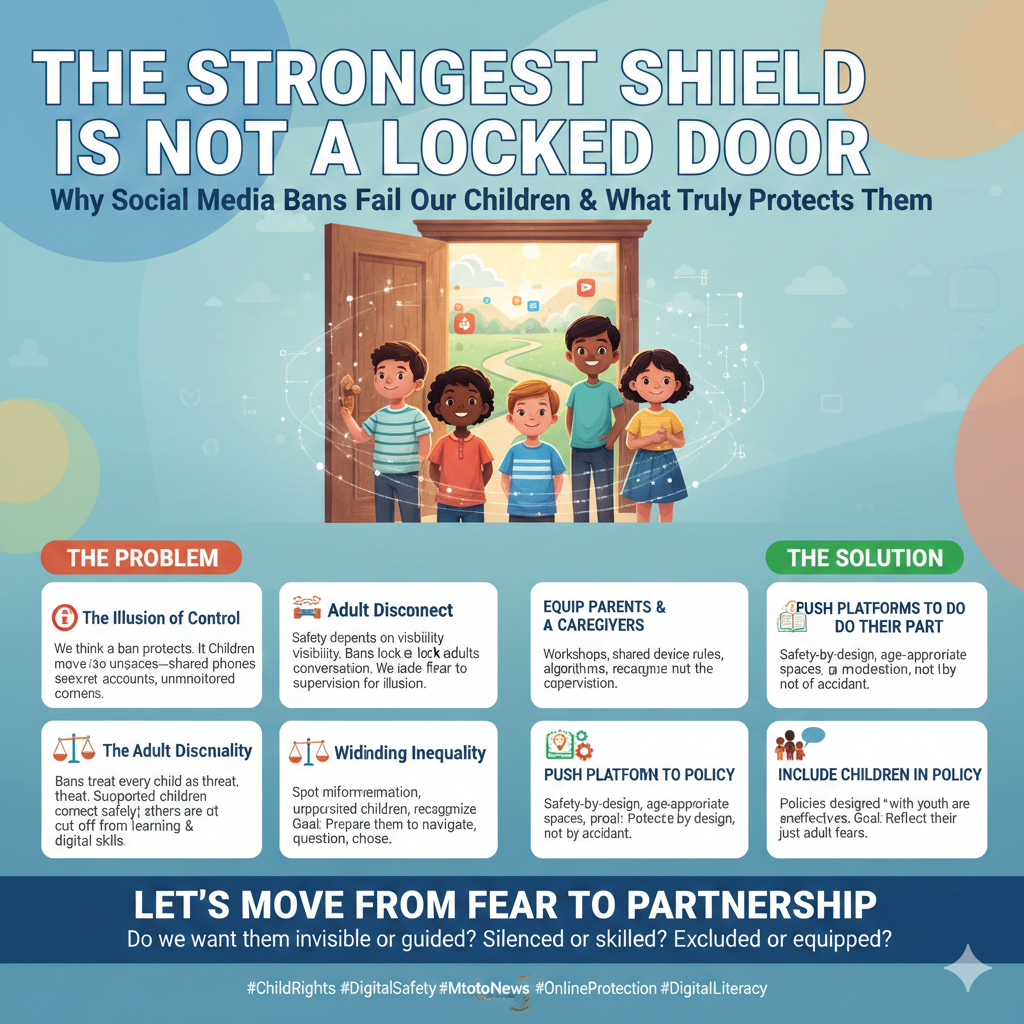
Children don’t disappear just because adults aren’t looking, they go to the unseen spaces where they will exist. We imagine bans as a shut door. In reality, they open another can of worms which might be darker and one adults rarely see. A banned or age-restricted platform becomes: a shared phone among friends, a borrowed login from an older sibling, a new secret account, or a move to platforms adults aren’t monitoring at all.
When children step into hidden spaces, risks grow: online grooming, bullying,misinformation, and exploitation.Safety depends on visibility. Bans take adults out of the conversation, right when children most need support and guidance.
Most children don’t go online to cause trouble and a sweeping ban treats every young user as a threat or a vulnerability. It also widens inequality. Children with support will still access social media through safer channels i.e guidance from a parent or sibling. Children without support are cut off completely from learning, connection, and future-facing digital skills.
There is an understanding that something should be done, and for parents who care, digital parenting is overwhelming. Social platforms change daily.The threats feel invisible and unpredictable.Teaching, regulating and supervising all feel complex and tiresome.
Fear moves faster than understanding. Bans become the shortcut not the solution.
What Works Better Than Locking Children Out
If we truly want safety, we need to shift from restriction to preparation.
- Equip Parents and Caregivers
Children learn safest online when an adult is present, curious and confident.
Workshops in schools, community training, shared device rules, and open conversations can arm caregivers with both knowledge and calm.
- Teach Media and Digital Literacy Early
This is the missing puzzle piece and it changes everything. Media literacy helps children:
spot misinformation, understand how algorithms shape their view of the world, recognise manipulation, false promises, and grooming tactics.
Digital literacy teaches them: how to manage privacy, when to block or report, how to assess risk, and when to ask for help.
- Push Platforms to Do Their Part
Safety shouldn’t fall on children and parents alone.
Platforms can design with young users in mind: safer defaults, age-appropriate spaces, limited searchability, better removal tools, proactive monitoring.
Technology should protect children by design, not by accident.
- Include Children in Policy
Children are not simply but experts in their own digital worlds. When rules are made without their voices, they fail to reflect their reality.
Policies designed with youth are smarter, more honest and more effective.
- Moving From Fear to Partnership
The question isn’t whether children belong online because they already are.
The real question is: Do we want them invisible or guided? Silenced or skilled? Excluded or equipped?
Safety isn’t hiding children from the world. Safety is preparing them to move through it, with adults walking beside them, steps steady, eyes open. If we invest in media literacy, digital skills, shared responsibility and thoughtful design, we give children more than protection. We give them power to navigate, question, choose, create and thrive.
Because the strongest shield is not a locked door.
It’s a child who knows how to open the right ones.